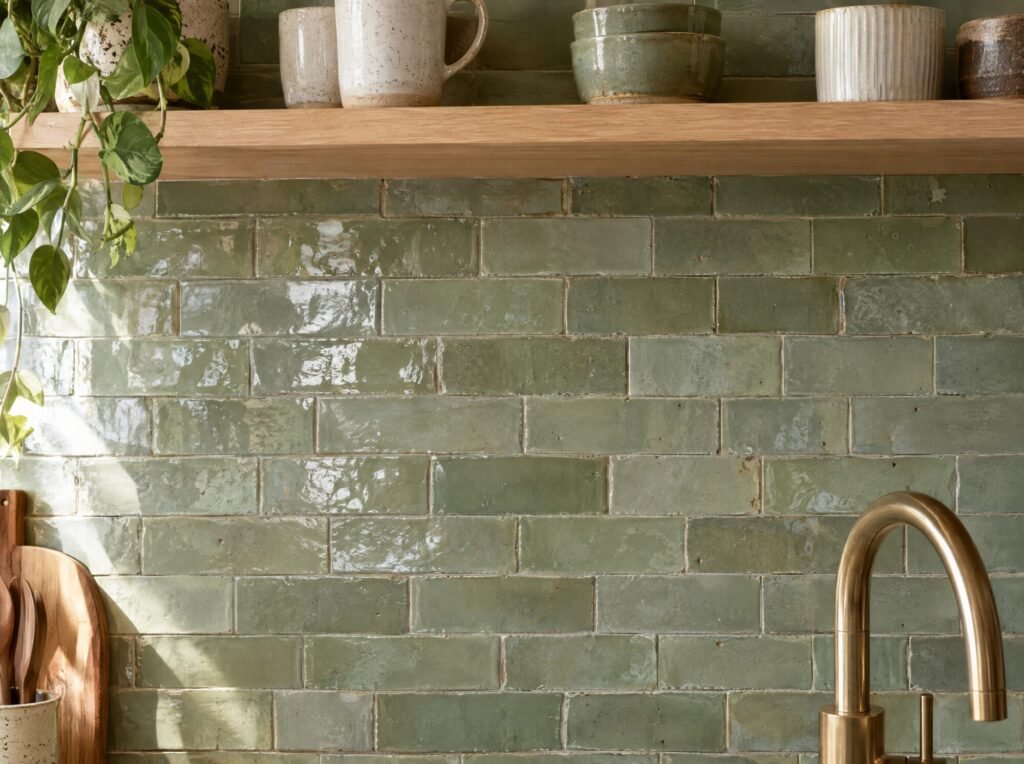
Zellige tile is a fun and creative way to bring your backsplash and kitchen to life!
Few tiles have taken over design feeds like zellige. Those glossy, rippled, slightly uneven tiles give a kitchen backsplash or shower wall a glow that flat, factory-perfect tile can’t match. They’re also a different animal to choose, budget for and install.
This guide is for both sides of the project: homeowners deciding whether zellige is right for them, and tile setters who want to install it so it looks intentionally handmade, not sloppy.
What is zellige tile?
Zellige (also spelled zellij) is a traditional glazed terracotta tile from Morocco, long associated with the city of Fez. Local clay is shaped, dried in the sun, glazed by hand and fired in kilns that are traditionally fueled with olive pits. The tiles are then cut to shape by hand.
That process is exactly why zellige looks the way it does. Every tile varies in color, thickness and edge shape. The glaze pools and ripples. Small pits, chips and crazing are part of the character, not defects.
For homeowners: is zellige right for you?
What you’ll love
- Depth and glow. The uneven glossy surface catches light differently across the wall, so even a single color looks alive.
- Character. No two tiles match, so the finished wall feels handmade and one of a kind.
- Timeless roots. It’s a centuries-old craft, not a trend invented last year, which helps it age well with many styles from Spanish Revival to modern.
What to be ready for
- Variation is the point. If you want a perfectly even surface with uniform color, zellige will frustrate you. Look at real installations, or a sample board of several tiles, before you commit.
- It costs more to buy and to install. The tile itself is handmade, and the installation takes more time because every piece has to be sorted, blended and set by eye.
- Walls are its best home. Backsplashes, shower walls, fireplace surrounds and feature walls are ideal. Most makers advise against using authentic zellige on high-traffic floors, where the soft body and glaze can chip.
- It usually needs sealing. Authentic zellige has porous edges and an absorbent clay body. Most suppliers recommend sealing it, and the grout, then resealing periodically. Follow your specific tile’s instructions.
- Order extra. Breakage and the need to cull odd pieces mean you’ll need more than the square footage. Many suppliers suggest 10–20% overage, and keep a few spares for future repairs.
Zellige-look alternatives
If you love the look but want something more consistent, easier to clean, or friendlier to a budget, many manufacturers now make zellige-inspired ceramic and porcelain tile. These are typically machine-made with a handmade-style glaze, so you get much of the shimmer and variation with flatter faces, more consistent sizing, and often no need for sealing.
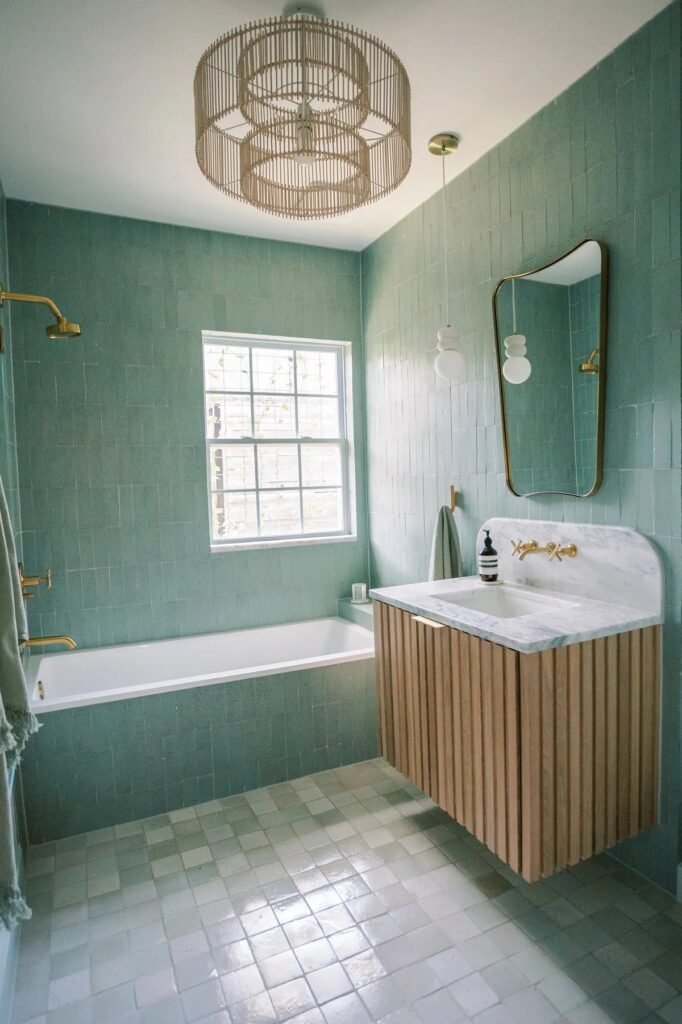
A good example is this bathroom by Fireclay Tile, a California tile maker. It uses a glazed thin brick in a rich turquoise that reads as zellige from across the room. Its vertical straight-set layout shows how a zellige-inspired tile can feel modern rather than traditional. See the full project on Fireclay’s site.
We know Fireclay’s tile well: Chevy Tile & Stone has bought from them as a trade customer since 2001, so we’ve seen firsthand how their handmade-style glazes look and handle on the wall.
The trade-off: up close, a zellige-look tile is more uniform than the real thing. Some people prefer that. Others want the full handmade irregularity. Neither is wrong.
For tile setters: how to install zellige well
Zellige rewards installers who slow down and set by eye. The goal isn’t to make it flat and perfect. It’s to make the irregularity look balanced and deliberate.
1. Prep a flat, sound substrate
The tile is irregular, so the wall shouldn’t be. Start with a flat, plumb surface so the only variation in the finished wall is the tile’s own character. In showers and wet areas, waterproof the full assembly first, just as you would for any tile.
2. Sort and blend before you set
Open several boxes at once and mix the tiles as you go. Pull out pieces with heavy chips or extreme color for cuts, low areas or behind appliances. Setting straight from one box at a time is how you end up with visible patches of lighter or darker tile.
3. Use the right setting method for uneven backs
Thickness varies from tile to tile, so full coverage takes extra care. Back-butter every piece and use a polymer-modified mortar appropriate for the tile and location, following the tile maker’s recommendations. Don’t chase a perfectly flat face. Set to an even average plane and let the edges do what they do.
4. Keep joints tight and consistent-looking
Traditional zellige is usually set with very tight joints, sometimes almost butted together. Because the edges are irregular, spacers often don’t work well; many setters space by eye to keep the overall rhythm even. Check your supplier’s recommendation for joint size.
5. Cut carefully
Use a sharp, clean wet-saw blade and expect some edge chipping on the glaze. Plan cuts so the factory hand-cut edges face the most visible areas, and save chipped pieces for cut locations.
6. Seal, then grout
Many installers apply a sealer before grouting so grout doesn’t stain the porous edges and the pitted surface, then seal again once the grout cures. Use a grout suited to the joint width (often unsanded for very tight joints) and clean as you go, because grout loves to hide in the pits and ripples. Always check the specific tile manufacturer’s sealing and grout instructions.
7. Set expectations with the client
The most important step happens before you start. Show clients a sample board or photos of finished zellige walls so they understand the chips, pits, color variation and lippage are part of the look. A client who expects porcelain-flat results will be unhappy no matter how well you install it.
Caring for zellige
- Clean with mild, pH-neutral soap and water.
- Avoid acidic and abrasive cleaners, which can damage the glaze and sealer.
- Reseal the tile and grout as the manufacturer recommends, especially in showers and behind sinks.
- Keep your spare tiles. Matching handmade tile years later is nearly impossible.
Frequently asked questions
Can zellige go in a shower?
Yes, on shower walls, as long as the shower is properly waterproofed behind it and the tile and grout are sealed according to the manufacturer. Most makers don’t recommend it for shower floors.
Why does zellige cost so much to install?
Every tile has to be sorted, blended and set by eye, with full coverage behind irregular backs, plus extra sealing and careful grouting. It simply takes more time than standard tile.
Is lippage normal with zellige?
Yes. Some edge-to-edge height difference is part of authentic zellige. A good installation keeps the overall surface even while letting individual tiles show their character.
Is zellige-look tile a good alternative?
Often, yes. Zellige-inspired ceramic or porcelain gives a similar glossy, handmade feel with more consistency and usually less maintenance.
Header image: illustration of a zellige backsplash (AI-generated).
Thinking about zellige, or a zellige-look tile, for your San Francisco or Marin home? We’ll help you choose between them and install it so the character shows in all the right ways. Request an estimate.